Your Followers Are Rented. Your Customers Can Be Yours.
Sep 28, 2026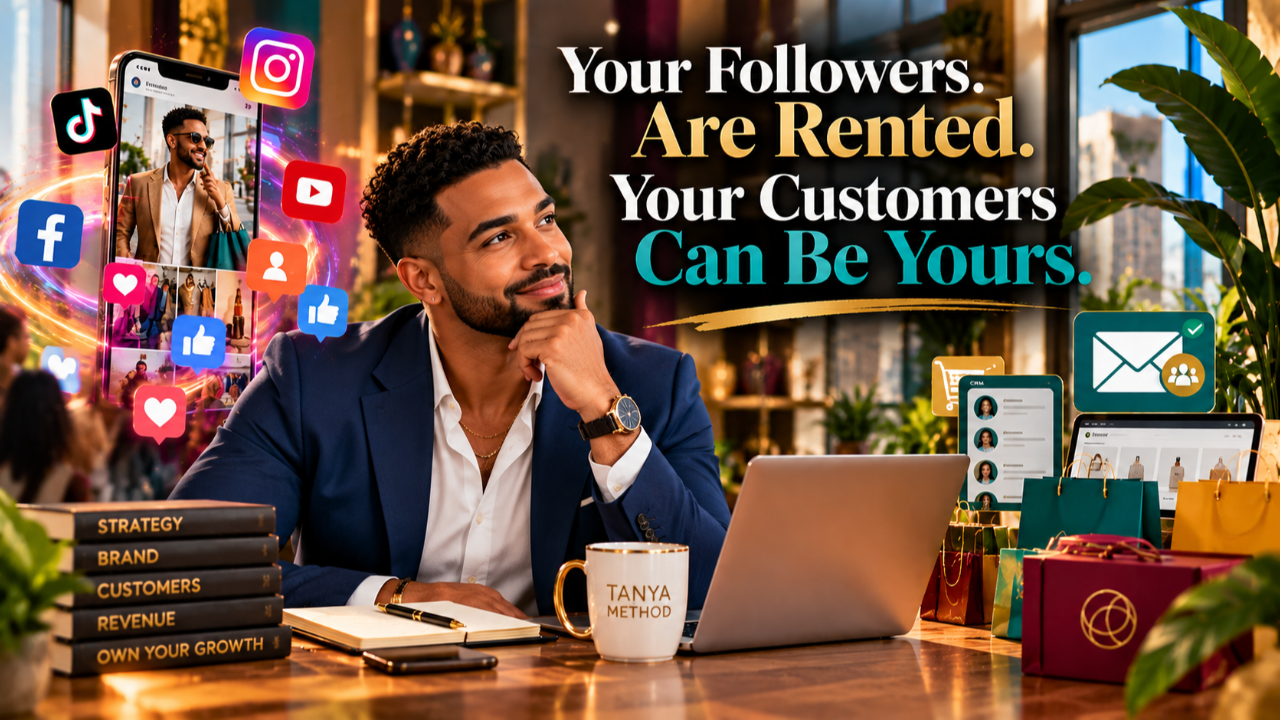
Social media introduced you to your people. Your website is where you get to keep them — and where retention turns into real, repeatable growth.
By LaTanya Junior, Founder, TANYA Method · 7-minute read · Learn Boldly. Grow Bravely. blog.
I’ve spent 25 years as an award-winning Cross & Multicultural CMO and Media Executive, trained at the side of Frank Mingo and shaped by Madison Avenue — and I’ve watched brands of every size learn the same lesson: the business that owns the customer relationship owns its future. After 600+ workshops and more than 10,000 entrepreneurs trained, I can tell you this lesson is no longer just for the big players. It’s yours.
Let’s start with something worth celebrating. If you’ve built a following on Instagram, Facebook, or TikTok, you did something real. You showed up. You created. You earned attention in one of the most crowded rooms in the world. That work matters, and it counts.
Now here’s the question I want you to sit with this week: who actually owns that audience?
Because if the honest answer is “the platform,” then what you’ve built isn’t a customer base yet. It’s a rental.
Renting vs. Owning: What’s the Difference?
When your customers live on a social platform, you’re a tenant. You’re building on someone else’s land, under someone else’s rules, with someone else’s algorithm deciding who gets to see your work. The platform controls your reach, your data, and your access. It can change the terms overnight, and it doesn’t need to ask you first.
When your customers do business with you on your website — when they join your email list, create an account, buy through your checkout, or sign up for your text list — you’re an owner. You hold the relationship. You know who they are, what they bought, when they last showed up, and how to reach them again without paying anyone for permission.
Renting isn’t wrong. Every business starts somewhere, and social platforms are one of the most powerful discovery tools small businesses have ever had. The mistake isn’t renting. The mistake is never buying.
Think of it this way: a landlord can raise the rent, rewrite the lease, or sell the building. None of that is personal. It’s just not yours.
What the Rent Really Costs
The rent on social media keeps rising, even when you’re not paying for a single ad.
Recent industry benchmarks put average organic reach at roughly 3% of followers on Instagram and somewhere between 1% and 2% on Facebook — and both have been trending down. Read that with your own numbers in mind. If you have 5,000 followers, an average post may reach fewer than 150 of them. The other 4,850 people who raised their hand and said “I’m interested” never see it.
And shrinking reach is the gentle risk. The harsher one is losing access altogether. In January 2025, TikTok went dark for U.S. users for roughly half a day. Throughout 2025, waves of automated account suspensions on Instagram and Facebook locked out business owners — many insisting they’d done nothing wrong — and left them waiting weeks for answers while their DMs, customer conversations, and shops sat frozen on the other side of the door.
For so many entrepreneurs of color — Black-owned brands, Caribbean diaspora businesses, founders serving the African continent and its communities abroad — social media has been a great equalizer. It’s where we found our people when traditional doors stayed closed. That’s exactly why this matters. The same platform that gave you a voice can turn the volume down without warning. Your community deserves a home that can’t be taken from you.
Social media is your storefront window. Your website is the store. Don’t let customers admire the window and never walk inside.
Why Your Website Is Home Base
Your website is the one piece of digital real estate you fully control. No algorithm decides whether your customers see your offer. No policy update rewrites your relationship with them. And every visit, sign-up, and purchase creates something platforms rarely hand over: your own customer data.
That data is where business intelligence begins. In Blog 13, we talked about benchmarks as your blueprint, not bragging rights. But you can’t benchmark what you can’t see. On a platform, you see likes and views. On your website, you see who bought, how often they return, what they spend, and when they start to drift. Those are the numbers that move through the Growth Loop — KPIs → Metrics → Analytics → Decisions → Strategy → Action → Repeat. Rented audiences give you vanity metrics. Owned audiences give you growth metrics.
Your website also does something quieter: it signals permanence. A customer who buys from your site, reads your story, and gets an order confirmation with your name on it experiences you as an established business — not a post that scrolled by. For entrepreneurs who have had to prove their legitimacy twice as hard, that credibility isn’t cosmetic. It’s strategic.
The Retention Impact: Where Ownership Pays Off
Here’s where owning versus renting stops being a philosophy and starts showing up in your profit.
Research widely attributed to Bain & Company found that increasing customer retention by just 5% can lift profits by 25% to 95%. Harvard Business Review has reported that acquiring a new customer can cost anywhere from five to 25 times more than keeping one you already have. Retention isn’t a nice-to-have. It’s the most profitable growth strategy most small businesses aren’t fully using.
In Blog 16, I asked you to pull your cost-per-acquisition and watch your margin monthly. Here’s the connection: in a year when costs are rising everywhere, every customer you keep is a customer you don’t have to pay to win again.
And retention depends on one thing above all: the ability to reach your customer again, on your terms. That’s what ownership gives you.
Consider email alone. Industry research from Litmus puts email marketing’s return at roughly $36 for every $1 spent. That return exists because email is owned. You’re not bidding against anyone for the right to talk to your own customer.
When customers live only on social, retention becomes a hope — you post and pray the algorithm shows them. When customers live in your ecosystem, retention becomes a plan. You can send a thank-you after the first purchase, a reminder when it’s time to reorder, a welcome-back offer when someone goes quiet, and an early invitation to your next launch. Every one of those touchpoints builds customer lifetime value, one relationship at a time.
We saw this in Blog 15, too. As November’s election-year noise drives up ad costs and crowds every feed, the businesses best protected are the ones with owned channels — email lists, text lists, and communities that no political ad auction can outbid. Ownership isn’t just a retention strategy. It’s insurance.
Moving Customers From the Feed to Your Front Door
You don’t need to abandon social media. You need to give it a new job: discovery. Let social introduce people to you. Let your website keep them. Here’s how to start building that bridge:
- Give them a reason to come home. People don’t hand over an email address for nothing. Offer something worth having — a guide, a first-order discount, early access, a free mini-lesson, or a members-only price.
- Make every post point somewhere. Your bio link, stories, captions, and pinned posts should lead to one clear place on your website — not five competing ones.
- Make the path simple. If signing up or checking out takes too many taps, people won’t finish. Walk your own path on your phone this week.
- Say thank you on your own turf. The first message after someone joins your list or buys from your site sets the tone for the whole relationship. Make it warm, personal, and useful.
- Track the move. Measure how many followers become subscribers, and how many subscribers become buyers. That conversion rate is one of the most important signals your business has.
Start small. You don’t need to move everyone this month. Even moving 10% of your most engaged followers onto your list changes your business — because those people are now yours to serve, not the algorithm’s to ration.
And keep showing up on social. The goal isn’t to leave the room where people discover you. It’s to make sure every conversation there has a door that leads home.
A Word Before You Close This Tab
If this post made you realize how much of your business lives on someone else’s land, that’s not a failure. That’s clarity. You built real attention. Now you get to turn it into real ownership — relationships you can nurture, measure, and grow for years.
Because Growth Is Not Magic — It Is A Method. And ownership is part of the method.
This Week’s Action Step
Before you post again, take five minutes and answer three questions honestly:
— How many of my customers could I reach today without a social platform?
— What would happen to my revenue if my main social account disappeared for 30 days?
— What’s one offer I could create this week to invite my followers onto my list?
Write the answers down. Then build your first bridge from the feed to your front door.
|
START HERE The Growth Circle Community is where entrepreneurs stop guessing and start growing — with live Signal. Strategy. Scale. sessions, Monthly Growth Loops, and on-demand access to everything in between. No contracts. Cancel anytime. Start With The Orientation Point · Free Course: www.TANYAmethod.com |
About the Author
LaTanya Junior is the founder of the TANYA Method™ and creator of the Learn Boldly. Grow Bravely. Sunday blog series. With 25 years as an award-winning Multicultural CMO and Media Executive, she was mentored by Frank Mingo of The Mingo Group and is part of the circle of marketers who helped shape Madison Avenue advertising. She has delivered 600+ workshops and trained and transformed over 10,000 entrepreneurs.
Her career includes Partner, Director of Strategic Planning at Ogilvy & Mather; Brand Manager, VP, Director of Media at Stedman Graham & Partners and Grey Advertising; CEO / Chief Marketing Officer at True One Agency; Director of Communications at Jackson State University; and growth strategist and leadership consultant to more than 10,000 small businesses.