Why Multicultural Marketing Isn't a Trend — It's Your Small Business Advantage
Jul 06, 2026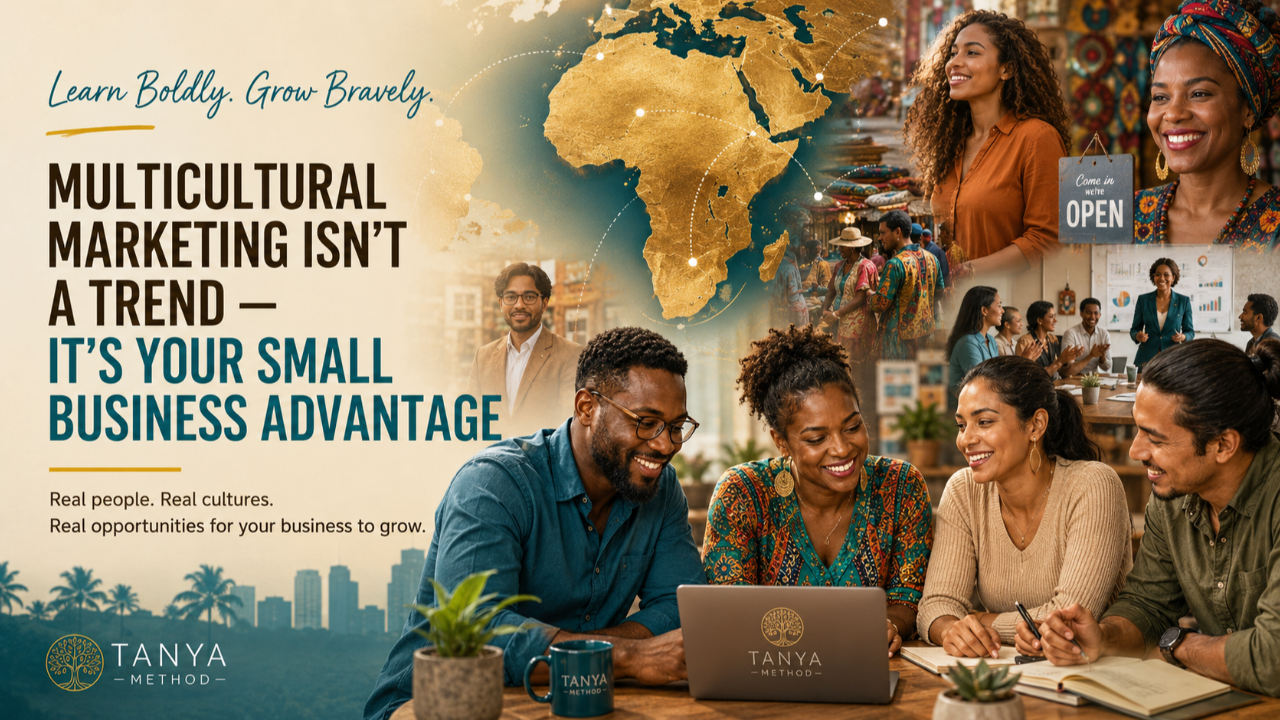
The market has already diversified. The businesses that build for it — not just around it — are the ones about to pull ahead.
By LaTanya Junior · July 6, 2026 · 7-minute read · Learn Boldly. Grow Bravely. blog
I've spent 25 years as a Multicultural CMO & Media Executive, mentored by the legendary Frank Mingo of The Mingo Group — so this isn't theory to me. It's the industry I helped build.
Let's start with something simple, because the simple truth is often the one we skip past.
Your customer base has already changed. Whether you've named it yet or not, the person buying from you today is more likely than ever to bring a different culture, language, or lived experience to that purchase than the customer you imagined when you first wrote your brand story.
This isn't a prediction. It's already happened. And it's still happening.
The question in front of every small business owner right now isn't whether to notice this shift. It's whether your marketing reflects it — or quietly assumes an audience that no longer matches reality.
The Market You're Already Serving
We talked about this in Blog 10 — brand search volume and direct traffic as identity alignment metrics. The people searching your name directly, the people who feel like they already know you before they click — that recognition doesn't happen by accident. It happens when your brand reflects the person looking at it.
The Census data backs this up at scale. Non-Hispanic white Americans are projected to fall below half the U.S. population within the next 25 years. Multicultural consumers already represent roughly 44% of all U.S. consumers today, and that share continues to grow every year.
This isn't a niche you're choosing to serve. It's the market. And it's worth looking at three groups in particular — because the data on each is not just significant, it's still widely under-acted-on by small businesses.
Black Consumer Buying Power: Loyalty That's Already Being Won or Lost
$2.1 Trillion in projected Black American buying power by 2026 — up 2.4x since 2000. (Nielsen Diverse Intelligence Series, 2026)
67% of Black consumers say they pay more attention to brands that reflect their culture, compared to 46% of consumers overall. (Nielsen Attitudes on Representation Study, 2025)
70% of Black consumers report they will stop buying from brands perceived as devaluing their community — up from 66% in 2023. (Nielsen, 2026)
Read that last one again. This isn't a market waiting to be persuaded. It's a market already deciding — with its dollars — who gets to keep it. Silence and generic messaging are themselves a message, and increasingly, it's one that costs the sale.
The Caribbean Diaspora: A Market Hiding in Plain Sight
This is one of the most overlooked multicultural markets in American business — and it's sitting inside cities most small businesses already operate in.
$18.4 Billion+ sent in remittances from the Caribbean diaspora in the U.S. in 2024 alone, illustrating disposable income left over after U.S. households, rent, and expenses are already covered. (Inter-American Development Bank)
$10–12 Billion in estimated annual economic impact generated by the Caribbean diaspora across remittances, consumption, and investment. (Carib Biz Network)
Caribbean American communities are concentrated in specific, identifiable metro markets — New York, Florida, New Jersey among them. For small businesses already operating in those markets, this isn't a distant demographic. It's a customer already walking past your storefront or scrolling past your ad, largely unaddressed.
Africa: Not Emerging. Defining.
We covered the entrepreneurship side of this in an earlier blog — African startups secured $3.1 billion in 2025, and 22% of working-age Africans are actively starting businesses, one of the highest rates on the planet. That same energy shows up on the consumer and cultural side.
Afrobeats is now one of the fastest-growing music genres globally, and the aesthetic, language, and cultural influence of the African continent is shaping fashion, beauty, and entertainment far beyond its borders. If your brand touches any of those categories — even at small-business scale — this is a market whose cultural gravity is already pulling on your customers, whether you've built for it or not.
And This Extends Further
Hispanic, Asian American, and other communities represent additional trillions in combined buying power and some of the fastest-growing consumer segments in the country. The principle holds across every group: authentic cultural relevance outperforms generic messaging, and consumers can tell the difference within seconds.
Possibility-first framing here, illustrated as a range rather than a prediction: analysts project combined multicultural buying power in the U.S. could approach $7 trillion by the mid-2020s — a scenario that underscores direction, not a guaranteed figure.
Why This Is a Small Business Advantage — Not a Small Business Problem
Here's where most of the coverage on this topic gets it wrong. Most multicultural marketing research is written for enterprise CMOs with seven-figure ad budgets. That's not you, and it doesn't need to be.
Cultural intelligence doesn't require a bigger budget. It requires attention. It shows up in:
— The imagery you choose for your website and social media
— The language and tone in your messaging
— The case studies and customer stories you highlight
— Who you partner with, feature, and hire
— Whether your pricing and offers reflect real accessibility, not assumed affluence
A small business with one team member who understands a community authentically will consistently outperform a large brand running a translated, surface-level campaign. That's not a consolation prize. That's the advantage.
A Framework, Not a Guess
This is where the TANYA Method comes back in. Reading your business signals — the same brand search volume and direct traffic metrics from Blog 10 — tells you who is already finding you and recognizing you before you spend another dollar acquiring someone new. Multicultural marketing done well isn't a separate campaign bolted onto your strategy. It's your existing strategy, made specific enough that real people see themselves in it.
An Opportunity to Go Deeper — Together
Because this subject deserves more than a single blog post, the TANYA Method is partnering with True One Agency on a multicultural marketing live workshop this fall — designed specifically for small business owners who want to move from awareness to action. Pre-registration opens September 2026, and we'll share full details as the date approaches.
Where You Begin
You don't need to overhaul your entire brand this week. Start with one honest look:
— Who is actually buying from you right now?
— Does your marketing reflect them, or an audience you assumed a while back?
— What is one authentic, specific adjustment you could make this month — not a full campaign, just one true adjustment?
That's the starting point. Not a rebrand. A recognition.
"Multicultural marketing was never a specialty. It was always the market. The businesses catching up now are the ones who will lead later." — LaTanya Junior
START HERE
If this post resonated, here is your next step:
Explore the TANYA Method www.TANYAmethod.com
Pre-Register Interest Starts: Augest 1st, 20206 · TANYA Method x True One Agency Multicultural Marketing Workshop, Fall 2026.
ABOUT THE AUTHOR
LaTanya Junior brings 25 years of award-winning experience as a Multicultural CMO & Media Executive. Mentored by legendary Frank Mingo of The Mingo Group, LaTanya is part of an elite circle of 360-degree multicultural marketers who helped design and shape the Madison Avenue advertising industry — work that also included time at Ogilvy. She is the founder of the TANYA Method™, a brand and business growth education platform for entrepreneurs and small business owners, and writes the Learn Boldly. Grow Bravely. blog every Sunday.