You Don’t Have a Data Problem. You Have a Clarity Problem.
Apr 19, 2026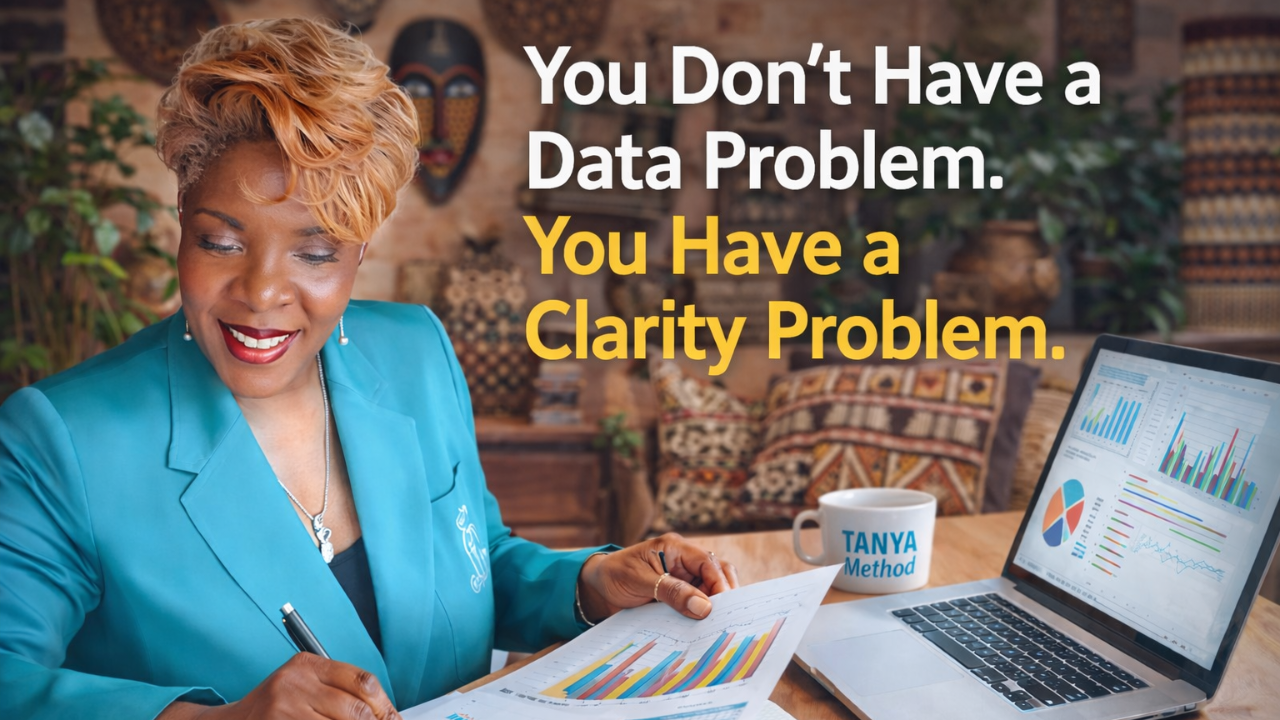
April 19, 2026,
By LaTanya Junior - LEARN BOLDLY. GROW BRAVELY.
Why most businesses are drowning in signals — and how to build a system that actually tells you what to do next.
Walk into any business meeting today, and you’ll find dashboards, reports, spreadsheets, and social media metrics — all competing for attention. Business owners are not starved for information. They are starved for meaning.
Three questions haunt leadership teams across every industry:
- What’s actually happening in my business?
- What does it mean for where we’re headed?
- What should I do about it — right now?
The tragedy isn’t that these questions go unanswered. It’s that they shouldn’t have to.
The Signal Flood Is Real — and It’s Costing You
We are living in the most data-rich era in human history, and businesses are feeling it. Research shows that humanity now generates over 403 million terabytes of data every single day — and the volume is accelerating, not stabilizing.
|
80% of workers now report experiencing information overload (OpenText) |
74% of professionals struggle to process data effectively (LumApps) |
$1T estimated annual cost of information overload globally (RPI) |
7.4x more likely to experience decision regret when overloaded (HBR) |
For small and mid-size businesses, the stakes are even higher. Research consistently shows that the challenge for SMBs is not a lack of data — it is a lack of translation. Without the right structure, the sheer volume of available information leads to analysis paralysis, missed opportunities, and slower growth.
“The challenge of small business analytics isn’t a lack of data. It’s a lack of translation.”
— Ascend Analytics, 2024
What’s Actually Missing
Most businesses have plenty of raw data flowing in from CRMs, accounting software, social channels, and website analytics. What they don’t have is a system to make sense of it all. Here’s what’s typically absent:
- Structured KPIs tied to actual business decisions — not vanity metrics
- Clear thresholds that trigger specific actions when crossed
- A consistent review cadence that closes the loop from insight to execution
- A shared language across teams about what “good” looks like
MIT Sloan Management Review and Boston Consulting Group found in a joint study of over 3,000 managers that legacy KPIs increasingly fail to deliver the information leaders need — they fall short in tracking progress, aligning teams, and advancing accountability. The result: decisions made on instinct rather than evidence, and strategies that reset every quarter without building momentum.
The Market Is Responding — But Most Businesses Aren’t Ready
The global business analytics market reached $96.6 billion in 2024 and is projected to hit $196.5 billion by 2033 (IMARC Group). The Business Intelligence market alone is expected to grow from $34 billion to over $65 billion in the same window. This surge reflects the market's urgent recognition of the need for structured data interpretation.
According to IDC, over 80% of companies worldwide will have incorporated data analytics as a core element of their digital strategy. But having a tool is not the same as having a system. Companies that revise their KPIs with AI-enhanced measurement are three times more likely to see greater financial benefits than those that don’t — but only when the metrics are tied to strategy, not just activity.
“A dashboard that tries to show everything shows nothing. Effective dashboards are focused, actionable, and audience-specific.”
— Devimus Analytics & KPI Guide, 2026
What a Strategy Loop Actually Looks Like
A repeatable strategy loop is not a luxury reserved for enterprise companies with full analytics departments. It is a discipline available to any business willing to get structured. The loop has three movements:
|
STEP 01 Diagnose Identify your 5–7 core KPIs. Track weekly. Know what numbers tell you the truth about your business's health. |
STEP 02 Interpret Context is everything. A revenue spike means nothing without knowing whether it came from new clients or a one-time windfall. |
STEP 03 Act & Adjust Every review ends with specific next steps. Measure the impact. Feed what you learn back into the next cycle. |
Industry benchmarking research from Bain & Company confirms that this kind of structured review process — comparing performance against clear benchmarks on a regular cadence — is what separates organizations that grow from those that guess. The frequency matters too: weekly tactical reviews, monthly channel reviews, and quarterly strategy reviews create layers of accountability that compound over time.
A Word to Business Owners Who Are Tired of Guessing
LaTanya Junior - Founder, TANYA Method
“You were never meant to run your business on gut feelings and hope. Every signal your business sends you is a conversation—it’s asking you to pay attention, to understand, and to respond with intention. When you build a system that translates your data into clarity, something shifts. You stop reacting and start leading. You stop second-guessing and start deciding with confidence. The numbers aren’t the story—you are. The numbers just help you tell it better. You deserve a business that works as hard as you do. That starts with knowing exactly where you stand, what it means, and what to do next. That’s not a luxury. That’s your strategy.”
Sources
OpenText Information Overload Report · Harvard Business Review · IMARC Group Business Analytics Market 2024–2033 · MIT Sloan Management Review & BCG, “The Future of Strategic Measurement” · Ascend Analytics SMB Report · Rensselaer Polytechnic Institute · Bain & Company Benchmarking Research · IDC Digital Strategy Report · LumApps Workplace Research 2025